A law firm’s website is marketing, and in Canada lawyers’ marketing is regulated by each provincial law society. The national model most provinces build on, the Federation of Law Societies’ Model Code of Professional Conduct, says marketing must be true, accurate and verifiable, must not mislead, and must be in the public interest. Those three tests rule out several things website templates are often built around: “best lawyer” headlines, results with no context, testimonial sliders and “specialist” badges.
This guide goes through what the rules mean for each part of a firm’s site, where Ontario, British Columbia and Quebec add their own, and what builds trust instead. It is general information, not legal or professional-conduct advice: your law society’s rules are the final word, and each source is linked.
The three tests every page has to pass
Under rule 4.2-1 of the Model Code, a lawyer may market legal services only if the marketing is true, accurate and verifiable, is neither misleading nor likely to mislead, and is in the public interest. Ontario’s rule follows the same structure. British Columbia’s (rule 4.2-5, amended in November 2024) prohibits marketing that is false, inaccurate, unverifiable, reasonably capable of misleading, or contrary to the public interest. The commentary on these rules explains what usually fails.
What the rules mean for each part of the site
- Results and case outcomes. The Model Code’s commentary says that citing amounts recovered or success rates may breach the rule unless the page also says that past results do not necessarily indicate future results and that outcomes depend on the facts of each case. A banner with a recovery total needs that context next to it, or it should go.
- Comparisons with other lawyers. Suggesting the firm is better than other lawyers, and disparaging them, are both listed in the commentary as marketing that may breach the rule. In Ontario, awards, rankings and third-party endorsements must be genuine and not misleading.
- Testimonials. The Model Code’s commentary flags testimonials or endorsements that contain emotional appeals. The Law Society of British Columbia said in an August 2025 ethics advisory that every element of a testimonial must be true and verifiable, so praise such as “great advice” is a problem, while an unsolicited online review that the firm does not reproduce is unlikely to count as the firm’s own marketing. In Quebec, the Barreau has told lawyers not to solicit client testimonials on social media or on a professional web page, and to remove promptly any that appear.
- “Specialist” and “expert”. Under rule 4.3-1 of the Model Code, a lawyer may not claim to be a specialist unless the law society has certified them, and the commentary says that without certification, calling yourself a specialist or an expert is misleading. Listing the areas the firm practises in, and describing experience accurately, is allowed. In British Columbia, a lawyer may name preferred areas of practice only if they regularly practise in each.
- Fees. If the site advertises fees, rule 4.2-2 of the Model Code requires them to be reasonably precise about the services each fee covers and to say whether disbursements and taxes are extra, and the firm must honour them. In Ontario, a firm that markets contingency fees must publish its maximum contingency percentage on its website. Quebec’s code of professional conduct for lawyers adds that advertised fees must be honoured for at least 90 days after the advertisement was last published.
- Who is a lawyer. Ontario requires marketing to identify each person as licensed as a lawyer, so each profile should say so plainly, along with where they are licensed.
The pages a law firm site needs
- A page for each practice area. What the process looks like, what a client should bring to a first meeting, the usual stages and what affects the timeline. Information, not predictions.
- A profile for each lawyer. Name, where they are licensed, languages, practice areas, and certified specialist status only where the law society has granted it, with the certifying body named.
- A fees page, if you advertise fees. What each fee covers, whether disbursements and taxes are extra and, in Ontario, the maximum contingency percentage if you take contingency matters.
- An intake form that protects confidentiality. A name, contact details, the other party’s name for a conflict check and a short description are usually enough. Many firms ask visitors not to send confidential details through the form until the firm has confirmed it can act.
- Disclaimers, terms of use and a privacy statement. The Law Society of Ontario’s practice review guidance lists them for websites, advertisements and social media pages.
- A French version, if the firm practises in Quebec. Our guide to bilingual websites for Quebec covers what that involves.
The rules every business site shares, such as privacy policies, email consent and accessibility, are in our checklist of website legal requirements in Canada.
What builds trust within the rules
The rules take away the shortcuts and leave the things clients actually check: who the lawyers are and where they are licensed, what the firm does and does not handle, how a matter usually unfolds, what it costs or how fees are worked out, and how quickly someone answers. A site that says those things clearly, in plain language, on a phone as well as a desktop, is both compliant and persuasive. Real photos of the team and the office help more than stock images of gavels.
Questions law firms ask about their website
How much does a law firm website cost?
It depends on how many practice areas need their own page, how many lawyers need a profile, whether intake runs through a simple form or a booking and conflict-check tool, and whether the firm needs a French version. One cost a law firm site carries that most others do not is the time to check every headline, profile and fee statement against the law society’s rules before launch. Our plans are on the pricing page, and our guide to what a professional website costs explains what moves the number.
Should a law firm use a website builder or a designer?
A builder can work for a sole practitioner who is happy to write and maintain every page and check every claim against the rules alone. A firm with several practice areas, lawyers and intake rules usually saves time with someone who builds the site and keeps it current. Either way, the law society’s rules apply to the result, not to the tool. Our guide to whether you need a designer or a developer covers the choice in more detail.
How we build law firm websites
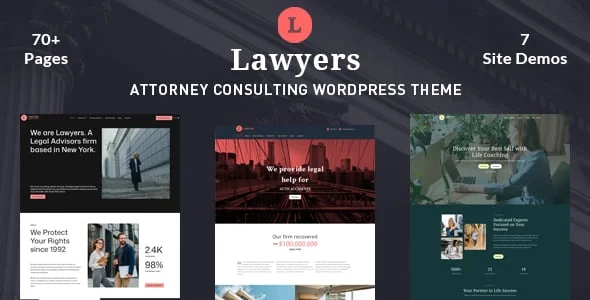
Our website design service starts from a design you choose, and our library includes more than a hundred designs made for law firms and attorneys, most of them in the Business section, such as LawBusiness and Libero. Their demo copy is written for a general market, so every headline, badge and testimonial section needs checking against your law society’s rules before launch. Every plan except Starter includes customizing the design with your own content, which is where that rewriting happens. Our portfolio includes an illustrative concept for a local law practice, which shows a customized design as a finished site. What each plan includes is on the pricing page.


If you run a firm, tell us your province and your practice areas, and we will tell you what the site needs.